
The dual pincers of tightening emissions regulations and rising fuel costs are pressuring the shipping industry to decarbonize. That is driving a strong incentive for shipowners and equipment manufacturers to rethink vessel design and lifecycle performance. Central to this transition is a critical question: what materials will make cleaner shipping durable, reliable, and economically viable over the long term?
For Outokumpu and Feen Marine, a specialist marine engineering company founded in 2013, the answer is stainless steel — especially Ultra 254 SMO®. This is a high-alloy austenitic stainless steel engineered to deliver exceptional corrosion resistance through its elevated chromium, molybdenum and nitrogen content, even in highly aggressive marine environments.
Together, with expertise from Europe and production capabilities in Batam, Indonesia, we have spent the past seven to eight years refining the performance of Exhaust Gas Cleaning Systems (EGCS), commonly known as “scrubbers”.
How emissions regulations drive scrubber adoption
On 1 January 2020, the International Maritime Organization (IMO) implemented a global cap reducing the sulfur limit in ship exhaust from 3.5% m/m to 0.5% m/m. Within designated Emission Control Areas (ECAs), i.e. the Baltic Sea, North Sea, and most North American coastal waters, the limit is stricter still at 0.1% m/m. The result is a projected 77% reduction in sulfur oxides (SOx) from global shipping, equivalent to approximately 8.5 million fewer metric tons per year.
Scrubbers have shown themselves to be practical and compelling solutions to achieve compliance. By removing SOx and particulate matter from exhaust streams, scrubbers enable continued use of heavy fuel oil (HFO) while satisfying regulatory thresholds. The economic case is also strong: HFO is much cheaper than low-sulfur alternatives. On a large container ship using 100 metric tons of fuel per day, and given a 300 USD per ton difference in price, daily savings from using converted HFO would be 30,000 USD.
Approximately 6,000 vessels globally now operate with scrubbers installed. Feen Marine alone has equipped over 500 ships. The Asia-Pacific region, which is home to the world's largest shipbuilding capacity and some of its most populated port cities and coastlines, is both the primary growth market for new scrubber installations and a direct beneficiary of cleaner marine exhaust.
How a marine scrubber works
EGCS is a wet scrubbing process. Exhaust gas from the ship's engine, laden with SOx, particulate matter, soot, and unburned fuel residues, is directed upward through the scrubber tower. There, it is brought into contact with a scrubbing liquid, typically seawater treated with an alkali such as sodium hydroxide (NaOH).
This chemical reaction converts SOx into sulfates such as sodium sulfate (Na₂SO₄), which are environmentally benign. Up to 98% of SOx emissions are eliminated in this process.
In a closed-loop system, the wash water is recirculated through a Water Treatment Unit (WTU), which removes heavy metals, soot particles, and unburned fuel oils before releasing the water within permitted discharge limits. Residual sludge is collected separately and offloaded at port for safe disposal, often dewatered into a dry cake using a filter press to reduce handling volumes.
What makes the operating environment so challenging from a materials standpoint is the combination of factors acting simultaneously: seawater chlorides, acidic scrubbing liquids, elevated temperatures from the exhaust gas stream, and the expectation that the equipment will provide reliable service throughout the vessel's operating lifecycle.
These conditions are why Feen Marine treats stainless steel selection as an integral part of the engineering design process.
Materials for a punishing environment
Since 2017, Feen Marine has standardized on Outokumpu's Ultra 254 SMO® across its EGCS product line. Ultra 254 SMO® is a high-alloy austenitic stainless steel developed and patented by Outokumpu for the most corrosive operating environments. With approximately 6% molybdenum content, it achieves a Pitting Resistance Equivalent (PRE) number of 43. This is a key benchmark for resistance to pitting and crevice corrosion in chloride-rich environments. The higher the PRE, the greater the protection.
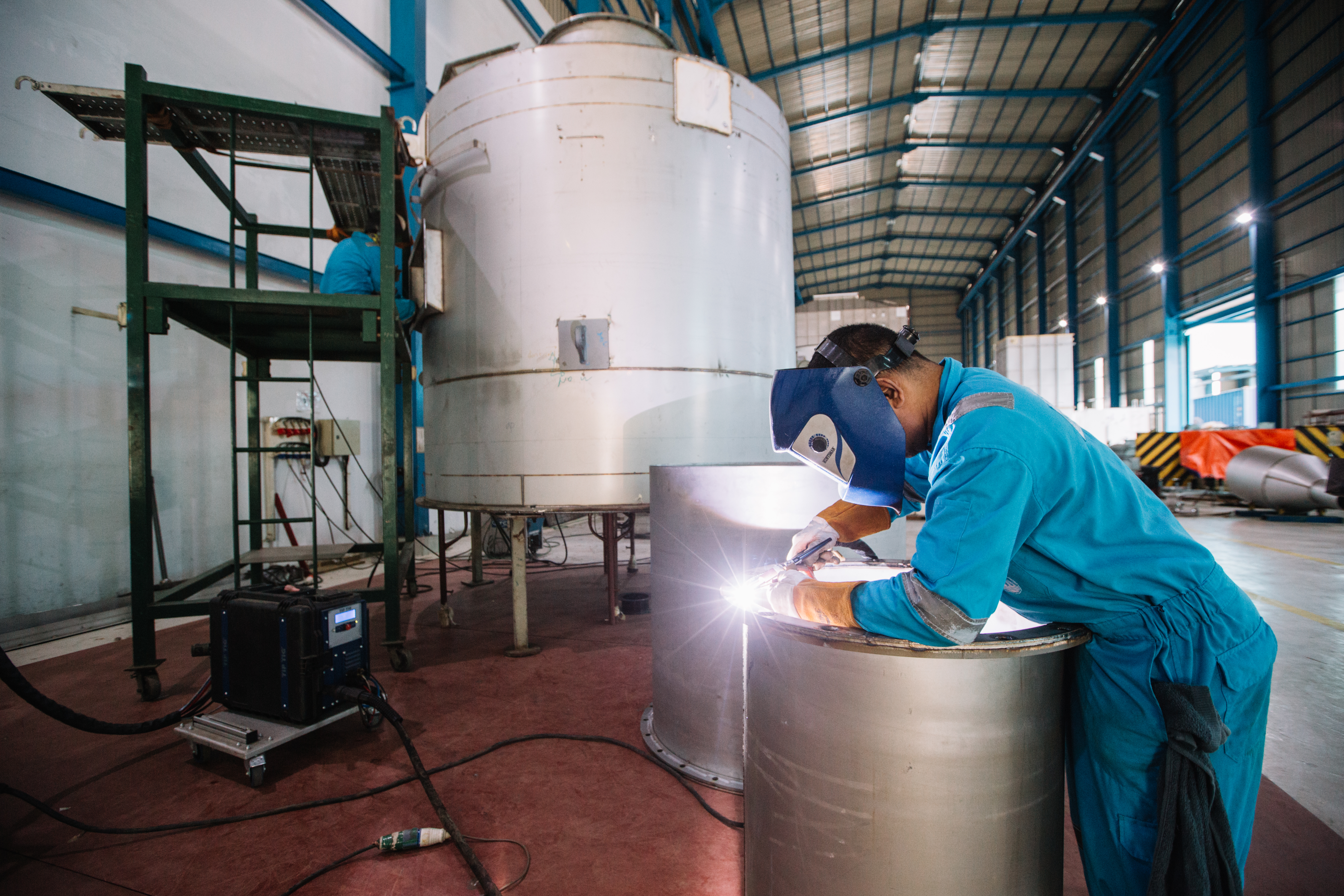
Beyond corrosion resistance, Ultra 254 SMO® is readily weldable and formable. That makes it well-suited to the rolling, bending, and welding processes Feen Marine uses to fabricate scrubber tower bodies and internal components from plate thicknesses of 2mm, 4mm, and 5mm.
Stainless from end to end
Feen Marine's use of Ultra 254 SMO® extends beyond the scrubber tower itself. The material is also applied in the combustion chamber of Feen Marine's Inert Gas Generator (IGG), a system used to produce inert gas for cargo tank blanketing on tankers.
Here, high temperatures and corrosive combustion gases combine to create particularly demanding material conditions. And yet, since the earliest EGCS installations in 2018 and 2019, Feen Marine reports zero corrosion-related failures on scrubber tower bodies manufactured from Ultra 254 SMO®.
With an estimated cumulative volume of over 2,000 tons of Outokumpu material procured and deployed to date, the performance record speaks directly to the material's suitability for sustained marine service.
Collaborative engineering for high-performance scrubbers
The foundation of this collaboration is technical. Outokumpu's R&D program on stainless steel for EGCS applications spans well over a decade. Material data, corrosion testing results, and application guidance informed Feen Marine's original selection decision, and ongoing engagement between Outokumpu's specialists and Feen Marine's engineers keeps material capabilities aligned with evolving requirements.
Feen Marine's systems are operating on vessels across major Japanese and European fleets. Nissen Kaiun installations include Norse Momentum, Falcon Ichiban, Golden Thetis, Maersk Ferrato, and Snow Flower; K Line vessels include Clover Colossus, Iris Bliss, Oceana River, and Falmouth Bay. These projects reflect Feen Marine's experience supporting major Japanese and European shipowners and demonstrate the company's growing international presence.
The future of scrubbers and cleaner shipping
“The scrubber market shows no sign of slowing down. With the majority of the global fleet still powered by heavy fuel oil and alternative propulsion technologies representing only a small fraction of active tonnage, EGCS will continue to play an important role in supporting emissions compliance for vessels operating on conventional fuels,” said Bjornar Feen, CEO and Founder of Feen Marine.
Emerging discussions around onboard carbon capture, which requires pre-treatment and cooling of exhaust gas, may also depend on scrubber infrastructure as a prerequisite, further extending the relevance of well-engineered EGCS equipment.
For Outokumpu, the collaboration with Feen Marine is a concrete demonstration of how high-performance stainless steel contributes not just to component durability, but to the broader goal of a cleaner maritime industry, in APAC and beyond.
To learn more about our work on marine scrubbers, visit: https://www.outokumpu.com/en/industries/marine/scrubbers
For more information on Feen Marine, visit: https://www.feenmarine.com/