
The greatest risk facing many organizations today is not uncertainty itself. It is delaying critical decisions while waiting for certainty to return.
Across North America, companies are making long-term investment decisions in an environment shaped by geopolitical shifts, evolving trade dynamics, infrastructure challenges, growing energy demand and relentless global competition. At the same time, they are being asked to strengthen resilience, improve competitiveness and accelerate transformation.
“Standing still is no longer a viable option.”
This tension between uncertainty and action was a recurring theme throughout Climate Week New York 2026. Across industries, the conversation has moved beyond setting ambitions. The focus is increasingly on implementation: how to make decisions today that create long-term business value while preparing organizations for a rapidly changing future.
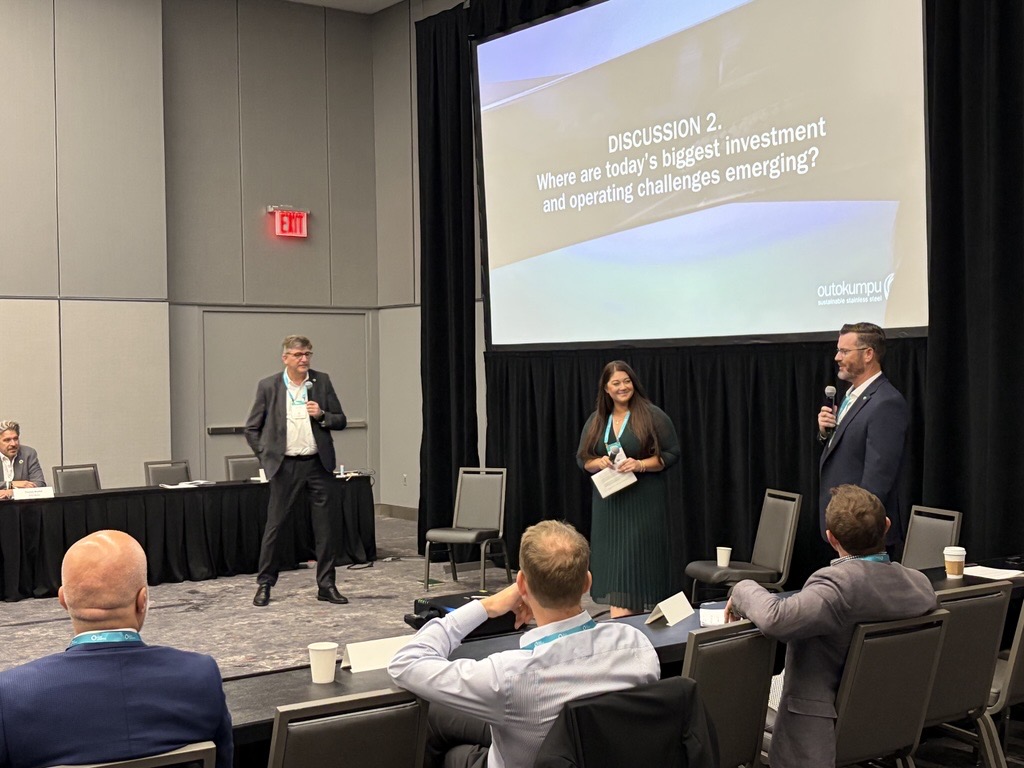
These same themes shaped Outokumpu hosted executive roundtable, Powering the Next Industrial Era: How Low-Carbon Materials Can Drive Competitiveness and Resilience, where leaders from across industries explored what resilience means in practice and how organizations can translate ambition into action. Three insights stood out.
Resilience Requires a Broader Definition of Value
One of the strongest themes emerging from both Climate Week and our roundtable was the growing recognition that resilience can no longer be evaluated through upfront cost alone.
Organizations understand the need to modernize infrastructure, strengthen supply chains, improve resource efficiency and reduce risk. Yet investment decisions are becoming increasingly complex. Leaders must balance cost, reliability, performance, material availability, operational efficiency, workforce considerations and long-term business risk. Every major investment now carries strategic consequences. Whether in manufacturing, transportation, energy transition or critical infrastructure, decisions made today will influence operational performance for decades. They affect maintenance requirements, reliability, resource consumption, supply security and, ultimately, long-term competitiveness.
"As a result, leading organizations are broadening how they define value. Instead of asking only what something costs today, they are increasingly evaluating lifecycle performance, business continuity, adaptability and future resilience."
This shift is particularly relevant as North America enters a new phase of industrial investment and renewal. Companies that focus exclusively on short-term economics may optimize for today's conditions. Companies that incorporate resilience into decision-making are often better positioned for tomorrow's realities. Competitiveness and resilience are no longer separate objectives.
We see this shift increasingly reflected in customer conversations. Organizations are looking beyond immediate purchase decisions and evaluating how materials, technologies and supplier partnerships can support broader business objectives over the long term. Our collaboration with Webco offers one example of how innovation and partnership can come together to create value across the value chain, helping advance solutions that support both performance requirements and sustainability ambitions.
Shaping the Future Requires Collaboration Across the Value Chain
A second conclusion emerged consistently throughout Climate Week: no organization can build industrial resilience alone. Many of today's challenges extend across entire value chains. Material producers, manufacturers, project developers, infrastructure owners, technology providers, policymakers and customers all influence outcomes. Yet too often, these stakeholders enter the conversation only after key decisions have already been made. The result can be missed opportunities, slower progress and solutions that optimize one objective at the expense of another.
Our roundtable highlighted the value of involving stakeholders earlier and more openly. When organizations collaborate from the outset, they are better positioned to evaluate trade-offs, align priorities and create solutions that deliver stronger outcomes across cost, performance, resilience and sustainability.
“The next industrial era will be shaped as much by partnerships as by innovation. Organizations that collaborate effectively across their ecosystems will be better equipped to turn complex challenges into competitive advantage.”
The discussion also highlighted a broader reality often overlooked in conversations about industrial growth. Expanding manufacturing capacity alone is not enough. Competitive and resilient industries depend on the entire ecosystem surrounding production, including technology, skills, infrastructure, energy systems, supply networks and materials. In other words, the world needs more than just factories. The long-term success of industrial investment will increasingly depend on how effectively these pieces work together.
Industrial Resilience Is Ultimately About People
While much of the discussion focused on supply chains, infrastructure and technology, one theme consistently brought the conversation back to first principles: resilience is ultimately about people.
“Industrial resilience is not simply about building stronger systems. It is about building a stronger future for the people who rely on them.”
Behind every manufacturing facility, transportation network, energy system and industrial asset are businesses, workers and communities that depend on those systems functioning reliably. Strong infrastructure supports economic growth. Reliable supply chains support jobs and investment. Competitive industries create opportunity and prosperity. When viewed through this lens, resilience becomes more than an operational objective. It becomes a long-term commitment to strengthening the foundations upon which businesses and communities depend.
This perspective also reflects an important shift in the broader conversation. Throughout Climate Week, many discussions moved beyond aspirational goals toward practical outcomes. The focus was increasingly on execution, economic opportunity and real-world impact. In many ways, this is a sign of progress. The conversation is no longer centered on why transformation is needed. It is increasingly focused on how to deliver it.
From Ambition to Implementation
Conversations with business leaders throughout Climate Week pointed in a consistent direction: resilience is no longer a future aspiration. It is a present-day business imperative.
The path forward is becoming clearer. Building resilience requires a broader definition of value, deeper collaboration across value chains and a commitment to keeping people at the center of industrial transformation.
Across industries, companies are already putting these principles into practice through new investments, new partnerships and new approaches to innovation. What once seemed like competing priorities are increasingly becoming drivers of the same outcome: long-term competitiveness.
The next industrial era will not be defined by uncertainty alone. It will be defined by how we respond to it.