
This content reflects Outokumpu’s understanding of the legislation and EU Commission guidance at the time of writing and is subject to change.
CBAM and stainless steel: your questions answered
This content reflects Outokumpu’s understanding of the legislation and EU Commission guidance at the time of writing and is subject to change.
Carbon Border Adustment Mechanism Frequently Asked Questions (FAQ)
What is CBAM and its impact on the steel industry?
CBAM is the EU’s Carbon Border Adjustment Mechanism, designed to prevent carbon leakage by ensuring imported products face a carbon cost comparable to EU-produced goods. It supports the EU’s climate targets by promoting fair competition and encouraging lower-carbon production globally.
CBAM puts a clear carbon price on imported materials such as steel, at the same time as the number of free emissions allowances under the EU Emissions Trading System (ETS) is gradually phased out. Therefore, European steel producers will need to increasingly pay for their direct emissions.
The amount will however depend on the level of direct emissions – and European stainless steel is significantly lower in emission intensity compared to average imported stainless steel
Who’s in scope? Where does stainless steel fit?
Coverage depends on customs classification of products, not producer grades. Always confirm your CN code against Annex I and the Commission’s guidance
Does CBAM cover all stainless grades and products?
The European Commission has published a self-assessment tool to help identify if a product is within the scope of CBAM goods. The tool provides EU importers with the possibility to get a quick overview on whether the imported goods are subject to CBAM during the transitional period, what the CBAM reporting requirements for that particular type of good are, and where to find further information. You will need the to know the Combined Nomenclature (CN) code to use this tool.
How does CBAM link to EU ETS? What's the timeline?
The price of CBAM certificates mirror the EU Emissions Trading System (ETS) carbon price, so importers face a similar carbon cost to EU producers. Free allowances for sectors covered by CBAM are being reduced progressively from 2026 to 2034 under the ETS Directive.
Now that the transition period from 2023–2025 (reporting only) is over, importers must buy and surrender CBAM certificates each year starting from 2026, with first payments to be made by the end of September 2027. The sale of CBAM certificates is expected to commence on 1.2.2027. Certificates for a given year of imported goods must be surrendered by end of September of the following year
Which emissions are accounted for under CBAM?
Included for iron and steel: direct (Scope 1) process emissions and emissions from specified precursors (e.g., ferrochrome, ferronickel, ferromanganese).
Indirect electricity emissions (Scope 2) are not included for the iron and steel sector at this stage.
What are SEE, Default Values and Actual Values?
SEE are the greenhouse‑gas emissions embedded in producing the imported good.
For calculating the number of required CBAM certificates, importers can use either Default Values or Actual Values as the embedded emissions of their CBAM goods.
Default Values are determined by the EU Commission and are assigned to specific product CN-codes based on their country of origin.
Actual Values can be applied when the SEE have been calculated under CBAM rules and verified by an accredited third party.
How are CBAM certificate needs and costs calculated?
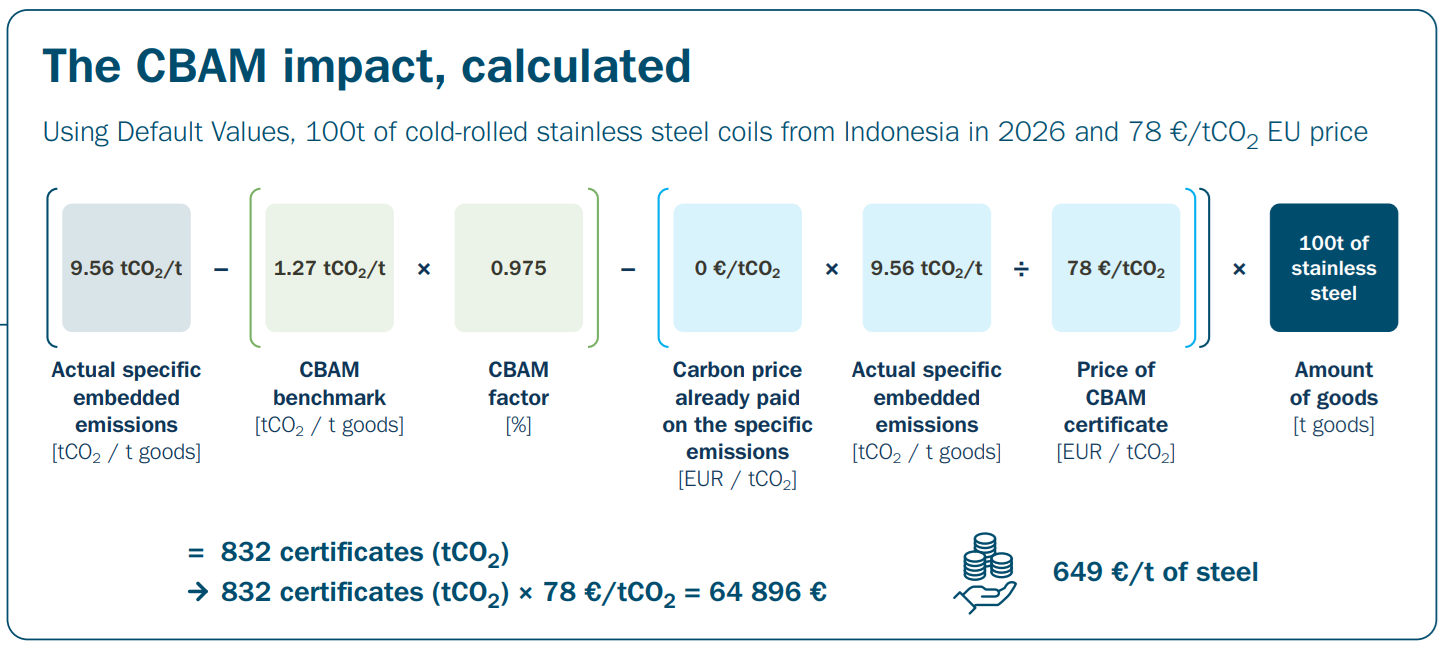
Certificates costs are equal to the number of CBAM certificates that cover the embedded emissions of imported CBAM goods (with possible deductions for the amount of free allowances phased out and recognized carbon costs already paid for in the country of origin) then multiplied by the price of CBAM goods.
Cost = number of CBAM certificates × price of CBAM certificate

Assumptions: Using Default Values, 1t of cold-rolled stainless steel coils from Indonesia in 2026 and 78 €/tCO2 EU price
(Actual specific embedded emissions – (CBAM benchmark x CBAM factor) – (Carbon price already paid on the specific emissions x Actual specific embedded emissions / Price of CBAM certificate)) x Amount of goods
( 9.56 tCO2/t – ( 1.27 tCO2/t x 0.975 ) – ( 0 €/tCO2 x 9.56 tCO2/t / 78 €/tCO2 ) x 1 t of steel
= 8.32 CBAM certificates needed (tCO2)
8.32 CBAM certificates x 78 €/tCO2 = 649 €/t of steel
Can carbon costs paid outside the EU be deducted?
Who is responsible for CBAM declarations and payments?
How does the EU prevent circumvention?
What if the Actual Values provided are not verified?
Are finished “complex goods” in scope now?
What's the market impact? Do steel safeguards interact?
How can my company reduce CBAM exposure?
CBAM exposure can be reduced by prioritizing lower‑emission supply routes and using supplier‑verified Actual Values to avoid conservative Default Values.
It’s also important to request product‑specific, third‑party‑verified emissions data aligned with CBAM.
Outokumpu’s European steel production is covered by the EU ETS and is therefore not subject to any CBAM costs. In addition, Outokumpu can provide product‑specific, externally verified carbon footprints for its products, to also cover its non-European production.
Based on life-cycle assessments (LCA), Outokumpu’s stainless steel has an average product carbon footprint of approximately 1.6 tCO₂e/t versus a global average of 7.3 tCO₂e/t, and thus over 75% lower. Outokumpu’s Circle Green products can go down to a product carbon footprint of 0.5 tCO₂e/t.
How can Outokumpu help?
Outokumpu’s European steel production is covered by the EU ETS and is therefore not subject to any CBAM costs. In addition, Outokumpu can provide product‑specific, externally verified carbon footprints for its products, to also cover its non-European production.
Based on life-cycle assessments (LCA), Outokumpu’s stainless steel has an average product carbon footprint of approximately 1.6 tCO₂e/t versus a global average of 7.3 tCO₂e/t, and thus over 75% lower. Outokumpu’s Circle Green products can go down to a product carbon footprint of 0.5 tCO₂e/t.